





Everybody's worried about new grads and AI.
Meanwhile the people who actually know how your business runs are sitting right in the middle of the org chart, and a lot of them checked out a while ago.
I'm talking about your midcareer professionals. Men and women 15, 20 years in. Not new, not retiring. Deep in it. They know which client will call on a Friday at 4:45. They know why the last reorg didn't work. They know the stuff that never made it into a manual.
And in the age of AI, that stuff is worth more than it's ever been. If anybody notices.
How do you reengage midcareer professionals?
The short answer: you reengage midcareer professionals by doing five things on purpose. Notice them. Recognize what they know. Encourage them out loud. Challenge them with real stretch. And give them a way to see their expertise actually contributing to something bigger than their inbox.
The fastest ways to make that happen are in person workshops, virtual workshops, group coaching, and one on one coaching built around the expertise they already have. Not another webinar about resilience.
Who counts as midcareer?
Midcareer professionals are people roughly 10 to 25 years into their careers, usually in their late 30s to mid 50s. Senior individual contributors, team leads, managers, the person everybody calls when the system goes down. They're nowhere near the beginning and nowhere near the end. They're in the middle, and the middle is where organizations quietly stop paying attention.
Why midcareer talent checks out
It's not a motivation problem. It's an attention problem.
Gallup found that only 32% of U.S. employees were engaged in 2025. Only 31% strongly agreed someone at work encourages their development. Only 28% strongly agreed their opinions count. Globally it's worse. Gallup's 2026 State of the Global Workplace puts engagement at 20%, and manager engagement fell to 22%.
Now put that next to research from the University of Surrey published in 2025 showing that job satisfaction for managers and professionals typically hits its lowest point in their 40s.
Read those together and it's pretty simple. The people with the most experience are the people least likely to hear that their experience matters. Nobody's developing them anymore because everybody assumes they're developed. Nobody's asking their opinion because they're "senior" and supposed to just know. So they do the job. They do it well, even. They just stopped bringing the extra.
Why AI makes midcareer expertise more valuable
There's a fear in a lot of companies that AI makes experience less valuable. The data says the opposite.
A 2026 analysis from the Federal Reserve Bank of Dallas found that AI tends to automate codifiable knowledge, the stuff you can write down, but not tacit knowledge, the stuff you only get from years of doing the work. Young workers in AI exposed fields are seeing a harder job market. Experienced workers in fields where experience pays are being complemented by AI, not replaced by it.
That's your midcareer people. Their judgment. Their pattern recognition. The client they saved because something "felt off" on a call. AI can draft the email. It can't tell you which customer is about to walk.
But tacit knowledge has a catch. It lives in people's heads. If they're disengaged, it stays there. And when they leave, it walks out the door with them.
Story from the stage: called up, not called out
When I was a walk on running track at Western Michigan University, I was doing bad. Like, really bad. Two years in and my coach, Jack Shaw, pulls me aside and says, "Tony, you're doing absolutely horrible."
Then he points out that our team has two of the best athletes in the country. One went to the Olympics. One went to multiple world championships. And I had never spent any time with either of them. I was hanging out by the high jump mat. Not bad people. Just not All Americans.
Coach Shaw didn't call me out. He called me up. He noticed me, he told me the truth, and he pointed me at people who would stretch me. I ended up all conference and earned a partial scholarship.
I tell that story on stages all the time because most midcareer professionals are waiting on their Coach Shaw. Somebody who sees them, tells them the truth, and expects more.
The 5 things midcareer experts need to reengage
1. To be noticed
Midcareer people become furniture. Reliable, always there, never looked at. Start by actually seeing them. Ask them what they're working on that nobody knows about. You'll be surprised how often the answer is "a lot."
2. To be recognized for what they know
Not a plaque. Specific recognition of specific expertise. "You're the reason the Chicago account renewed" lands. "Great job this quarter, team" doesn't.
3. To be encouraged
Remember that 31% stat? For a lot of people, development quietly stops somewhere in the middle. Encouragement sounds like "I think you'd be great at teaching this to the new folks" or "I want your take before we roll this out."
4. To be challenged
This one gets missed the most. Experienced people don't need to be protected. They need to feel butterflies again. Give them a stretch assignment, a room to lead, a problem nobody's cracked. If nobody feels any discomfort, nobody's growing.
5. To know they're contributing
People want their expertise to matter beyond their own desk. Let them mentor. Let them shape how your team uses AI. Let them see the line between what they know and the people it helps. That's the part that brings people back.
The best ways to reengage midcareer professionals
There's no one right format. It depends on your people, your budget, and how much time you've got.
In person workshops
Best when you want energy in a room and real conversations between people who don't usually talk. A half day or full day session where midcareer leaders map their own expertise, name what they know that nobody else does, and leave with one stretch commitment for the next 30 days. Great for leadership offsites, annual meetings, and team kickoffs.
Virtual workshops
Best for distributed teams and for keeping momentum without the travel budget. Usually a series of 60 to 90 minute sessions over a few weeks so people can try things between sessions and come back with what happened. Same idea as in person, built for the screen, with breakouts that actually get people talking.
Group coaching
Best for a cohort of 6 to 12 midcareer leaders who need accountability over time. Peers coaching peers, with me in the room keeping it honest. This is where the "allies" part shows up. People find the folks who stretch them and keep showing up for each other long after the program ends.
One on one coaching
Best for high potential leaders, people stepping into bigger roles, or experts you can't afford to lose. This is where we get specific. We pull out what they know, the tacit stuff, and turn it into something they can teach, lead with, and use alongside AI tools instead of feeling replaced by them.
How I work with organizations
To be clear, I'm not coming in to give your people a pep talk and leave.
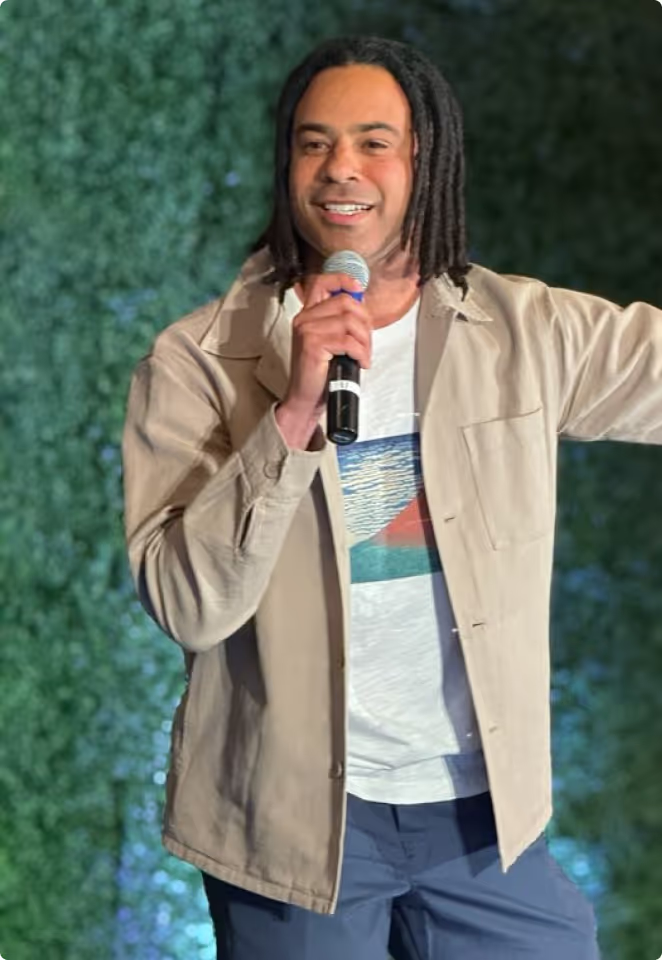
I spent years as a journalist at places like NBC and PBS interviewing people about how they do what they do. That's still how I work. I ask questions, I listen for the expertise people don't realize they have, and I help them put it into words. After 400+ keynotes, the most common thing I hear after a session is some version of, "I forgot I knew all that."
Most engagements look something like this:
- Keynote to open the conversation with the whole organization or event.
- Workshop, in person or virtual, for midcareer leaders to go deeper.
- Coaching, group or one on one, to keep it going for the 30, 60, 90 days after, when most inspiration fades.
Some clients want all three. Some want just one. It fits best when you've got experienced people who are good at their jobs and quietly checked out, and you want them teaching what they know instead of sitting on it.
FAQs
Q: Why are midcareer employees disengaged?
A: Mostly because they stop being noticed. Development, recognition, and new challenges tend to go to early career talent and senior executives, and the middle gets assumed. Research from the University of Surrey shows job satisfaction for professionals and managers typically bottoms out in their 40s.
Q: Is AI a threat to midcareer professionals?
A: For people with deep experience, AI looks more like a complement than a replacement. Dallas Fed research found AI tends to automate knowledge that can be written down, while tacit knowledge from years of experience stays valuable.
Q: What's the best way to reengage experienced employees?
A: Notice them, recognize their specific expertise, encourage their development, challenge them with real stretch, and give them ways to contribute beyond their role. Workshops and coaching work well because they make that happen on purpose instead of by accident.
Q: Should we do a workshop or coaching?
A: Workshops are great for energy and shared language across a group. Coaching is where behavior actually changes over time. Most organizations get the best results pairing a workshop with group or one on one coaching after.
Q: Do you offer virtual workshops?
A: Yes. I run both in person and virtual workshops, plus group and one on one coaching for midcareer leaders.
Final Word
Your best people might not be your newest people. They might be the ones who've been there 15 years and haven't been asked a real question in five.
The expertise is already in the building. It's just waiting on somebody to notice.
If that's your team and you want to talk about a workshop, coaching, or a keynote to kick it off, let's talk. Tell me a little about your people. I want to know.
